Medical contract manufacturing provides medical device companies with a production pathway that scales with demand without the capital requirements of building and maintaining their own manufacturing facilities. The medical device industry has adopted contract manufacturing extensively because it allows companies to concentrate resources on design, regulatory affairs, and market access while accessing the manufacturing capabilities, quality systems, and operational experience of specialist contractors.
How Medical Contract Manufacturing Works
In a medical contract manufacturing arrangement, the device company provides the device design, the manufacturing specification, and the quality requirements. The contract manufacturer provides the facility, equipment, quality systems, and personnel to produce the device to those specifications. The device company retains design authority, regulatory responsibility, and ownership of the intellectual property. The contract manufacturer produces the device on behalf of the customer.
The relationship is formalised in a contract that covers manufacturing scope, quality requirements, intellectual property, confidentiality, and supply commitments. A quality agreement, typically a separate document from the commercial contract, specifies each party’s quality responsibilities, the handling of non-conformances, and the audit rights that the device company retains over the contractor’s manufacturing operations.
Regulatory Aspects of Medical Contract Manufacturing
Under ISO 13485, the medical device company is required to manage its suppliers, including medical contract manufacturers, as part of its quality management system. This includes qualifying the contractor before awarding production, auditing the contractor’s quality systems, and monitoring performance on an ongoing basis.
The FDA, in its oversight of medical device companies, may audit a contract manufacturer’s facility if the contractor is producing a significant proportion of the device or is performing a critical manufacturing step. The device company’s responsibility extends to ensuring that its contractors maintain the quality and regulatory compliance required.
“Singapore contract manufacturers have built a track record that makes them trusted partners for global medical device companies,” said EDB’s Head of Biomedical Sciences Lim Yew Teck. Medical contract manufacturing based in Singapore carries that trust as a commercial asset.
Scaling Production Through Contract Manufacturing
One of the principal advantages of medical contract manufacturing is the ability to scale production volume in response to market demand without capital investment by the device company. A contract manufacturer with available capacity can increase production volume for an existing product relatively quickly. A contract manufacturer with the appropriate process capabilities can take on new products through the qualification and validation process.
For medical device companies launching new products, starting with contract manufacturing for the initial market introduction, then scaling through the same contractor or transitioning to internal production as volume justifies, is a common strategy. The medical contract manufacturer takes on the manufacturing risk during the period when volume is uncertain.
Process Validation in Medical Contract Manufacturing
Manufacturing processes for medical devices must be validated before production begins. In a contract manufacturing setting, the validation is performed at the contractor’s facility and with the contractor’s equipment. The validation data belongs to the device company and forms part of its regulatory documentation.
Changes to validated processes must be evaluated and, where significant, re-validated. The contract manufacturing agreement should specify the change notification and approval process that applies to manufacturing changes.
AMT Medical Contract Manufacturing
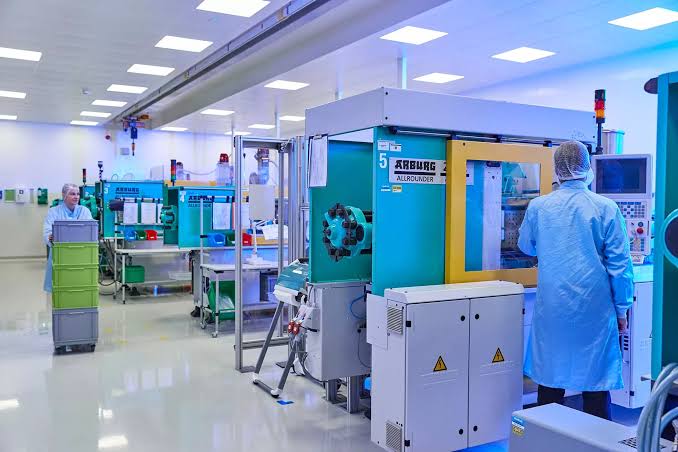
AMT provides medical contract manufacturing services from its Singapore facility, covering metal injection molding, precision machining, and cleanroom assembly within an ISO 13485 quality management system. Their team supports customers through process development, validation, and series production with the regulatory documentation and quality oversight that medical device production requires.